
Projects
List of projects:
- Neural basis of speech articulation and high-level language processing
- Characterization of the non-canonical language regions in the brain
- Brain basis of bilingualism
- Interesting Brains
Neural basis of speech articulation and high-level language processing
In this line of my research I explore the functional specialization of the speech-articulation and high-level language system. Since speech production has often been studied using paradigms that conflate language processing and articulation (e.g., picture naming), it is unclear to what extent these two functions rely on independent or overlapping mechanisms.
The aims of this project include:
➡️ developping a speech articulation localizer paradigms, which would allow to efficiently identify articulation regions without using language stimuli
➡️ characterizing functional profiles of the articulation regions relative to the neighbouring high-level language areas
key results:
Speech articulation engages a bilateral set of temporal and sensimotor regions which show very different functional profiles than the fronto-temporal language system:
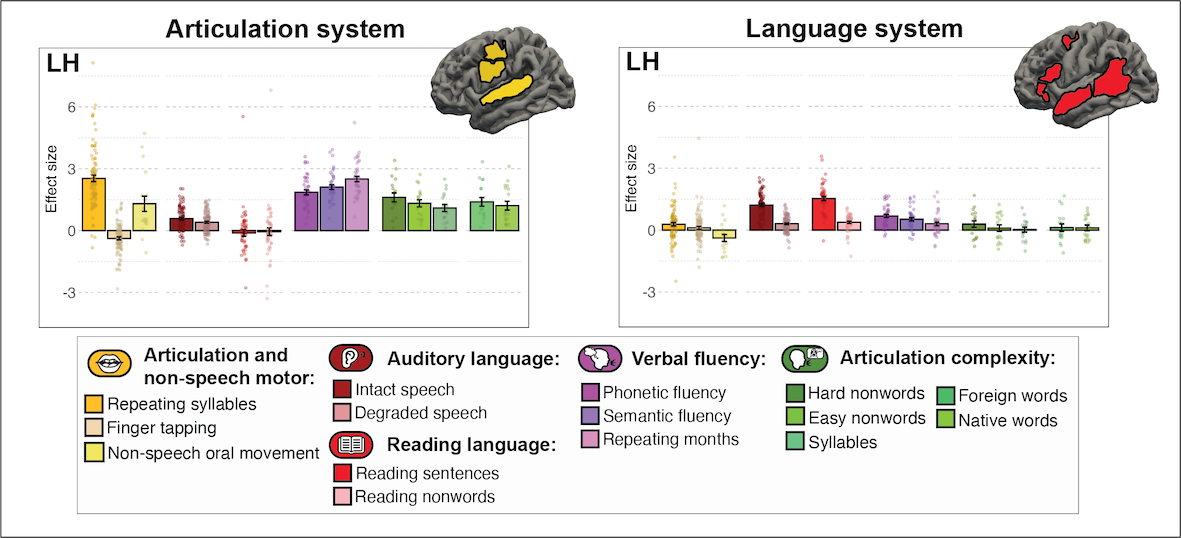
Look out for a preprint comming soon!
Characterization of the non-canonical language regions in the brain
In this line of my research I study the characteristics of the high-level language system in the brain, including, but not limited to:
➡️ identification and characterization of the non-canonical language regions
- key papers:
➡️ the lateralization of langauge & its relationship to the lateralization of the neighbouring speech articulation and speech perception systems
Brain basis of bilingualism
In this line of my research I study the brain basis of bilingual language processing and how this process is supported by the bilingual language control mechanisms. Key questions include:
➡️ How does speech production in bilinguals (in single language and dual langauge context) engage the langauge and the domain-general executive control systems?
- key papers:
- Wolna, A., Szewczyk, J., Diaz, M., Domagalik, A., Szwed, M., Wodniecka, Z. (2024) Domain-general and language-specific contributions to speech production in L2: an fMRI study using functional localizers. Scientific Reports 14(57). DOI PDF
- Wolna, A., Szewczyk, J., Diaz, M., Domagalik, A., Szwed, M., Wodniecka, Z. (2024) Tracking components of bilingual language control in speech production: an fMRI study using functional localizers. Neurobiology of Language. 5(2): 315–340. DOI PDF
- Lin, K.Y^., Wolna, A^., Szewczyk. J., Timmer, K., Diaz, M., Wodniecka, Z. (2026) Exploring Neural Mechanisms of Language Switching: An fMRI Study Using a Functional Localizer Approach. BioRxiv (Preprint) DOI
➡️ Is the langauge system of bilinguals different than in monolinguals? Does L1 and L2 share neural resources, or they rely on partially separate systems?
key results:
The same language system supports processing of both L1 and L2. However, similar to language production (see Wolna et al., 2024), comprehension in L2 engages additional language-specific resources. In addition, it is related to small but consistent increase in engagement of the domain-general multiple demand system. 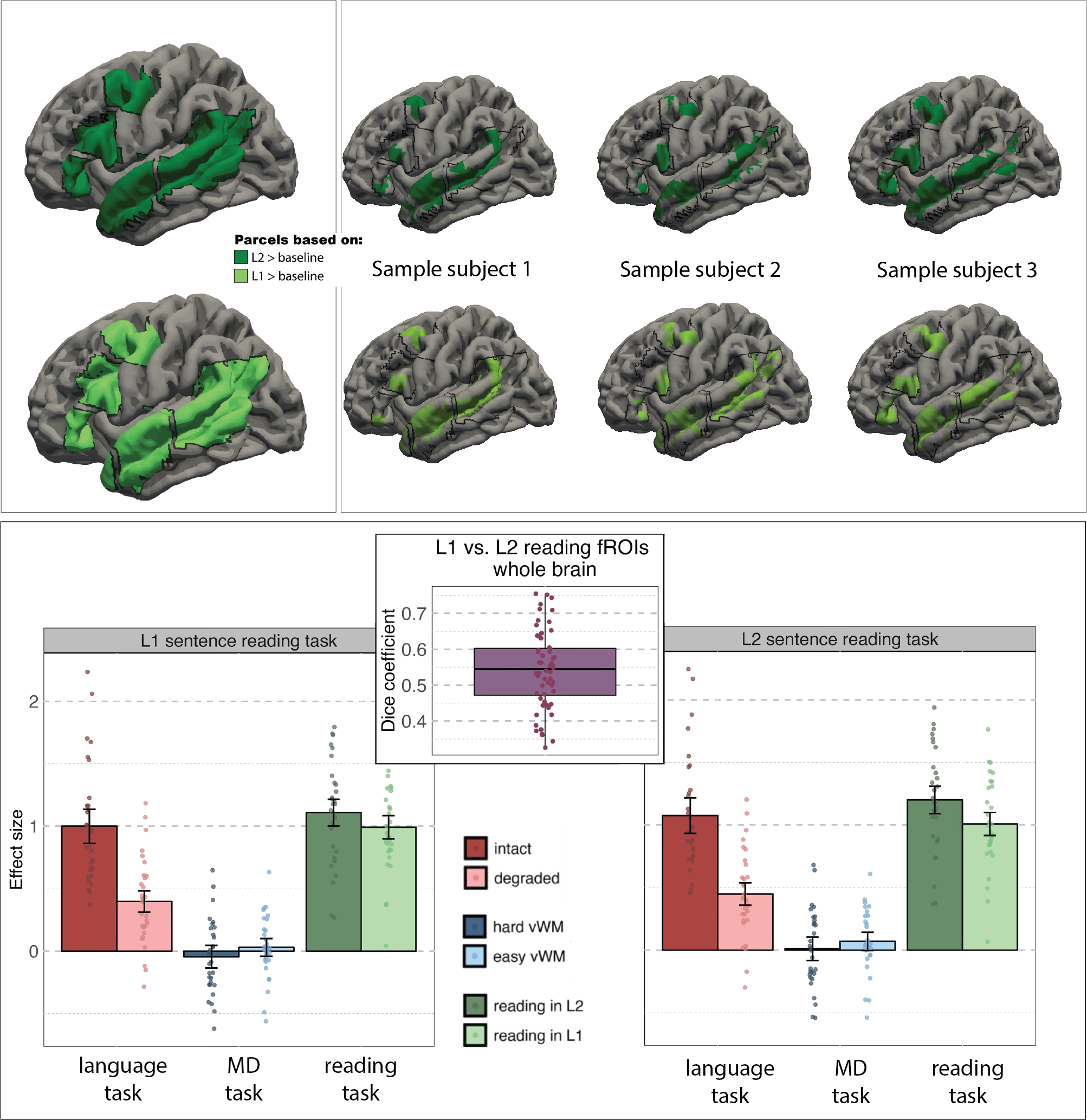
This project is funded by the PRELUDIUM grant from the National Science Centre in Poland. 
Look out for a preprint comming soon!
Interesting brains
What are the limits of functional specialization in the brain? How does it look like in anatomically atypical brains? In this project we ask this question by looking at a very special population: individuals with significant innate or early lesions in the brain (including cysts of different origins, early stroke, and surgical resections) who despite their unique anatomy live largely symptom-free lives.
Read more about Interesting Brains here